CODE OF CONDUCT
Included:
Guidelines for Appropriate Behavior with Minors
Preventing Harmful Relationships with Minors
Appropriate & Inappropriate Interactions
How to Report Suspected Abuse or Neglect of a Minor
Confirmation of Understanding
1. Guidelines for Appropriate Behavior with Youth Participants
As Mirror Image Arts employees and volunteers it is our duty to prevent harm towards all youth participants in our care. The purpose of these guidelines is to provide a safe environment for both staff and minors, and to raise awareness of how to manage risk when minors are present in our programs and our facility. Youth Participants include any youth under the age of 26 years old. “Staff” includes both employees of Mirror Image Arts and volunteers. This policy will be provided to all new staff upon hire, and reviewed with returning staff on an annual basis. These guidelines emphasize the responsibility that staff and volunteers have in ensuring a safe and successful program and environment.
Best Practice For Safely Working with Youth Participants
I will…
Avoid being alone with a single youth participant where I cannot be observed by staff or other adults (‘two-adult rule”).
Not discipline minors by use of physical punishment or by failing to provide the necessities of care.
Treat all youth with respect, dignity, and fairness and acknowledge that physical, verbal, emotional, or sexual abuse of minors is unlawful and is prohibited by state law and the Mirror Image Arts Policy.
Serve as a positive role model in my language, actions, and appearance and will wear clothing that is modest, appropriate, and free from offensive language or images.
Actively supervise youth and ensure their safety in all spaces.
Use only verbal methods to de-escalate conflicts between youth; use physical intervention only if necessary to prevent harm, and report any such incidents to my supervisor immediately.
Communicate to my direct supervisor all situations that may be questionable or a possible breach of these guidelines. If I believe someone has perpetrated abuse or neglect, I will immediately and confidentially report such violation to Child Protective Services or the police, and follow MIA guidelines for internal reporting, as applicable.
Cooperate fully with any investigation of misconduct or safety concerns.
Not have off-hours contact with youth participants. For my well-being and the well-being of the organization, I will separate my private life from my work or volunteer activities.
Provide clear communication about the program at all times. Communicate the codes of conduct/rules/behavior to staff and youth participants at the onset of each program or event.
Clearly communicate to all Youth participants that they are not allowed on program premises without a staff member present.
Conduct no Internet social networking with minors for personal reasons.
Follow the program emergency plan for responding to a crisis situation. In case of emergency, I will contact emergency contacts as soon as possible.
I will not…
Engage in private communication with youth outside of official program channels (including texts, calls, or social media).
Allow bullying, hazing, or harassment of any kind.
Withhold basic needs (food, water, bathroom, medical care) from any youth. Allow minors to supervise other minors without adult oversight.
Ignore or fail to report any suspected abuse, neglect, or policy violations.
2. Preventing Harmful Relationships with Minors: The following are specific actions staff can follow in order to avoid harmful relationships with minors.
Establish clear boundaries with minors, i.e. stating what are or are not appropriate conversation topics.
Do not have inappropriate physical contact (see chart below).
Treat all minors equitably, i.e. fairly and consistently. Avoid showing favoritism
Follow appropriate professional attire guidelines and avoid provocative or revealing attire.
Do not allow youth participants in your living quarters.
Do not transport minors in a private vehicle without explicit program permission.
Do not discuss your own or participant’s sex life or activities.
Do not smoke or drink alcohol in the presence of youth participants.
Do not share sexually explicit literature, magazines, books, music, or videos.
Seek support for high risk situations, such as discussions of very personal stories.
When in doubt, seek assistance from a supervisor.
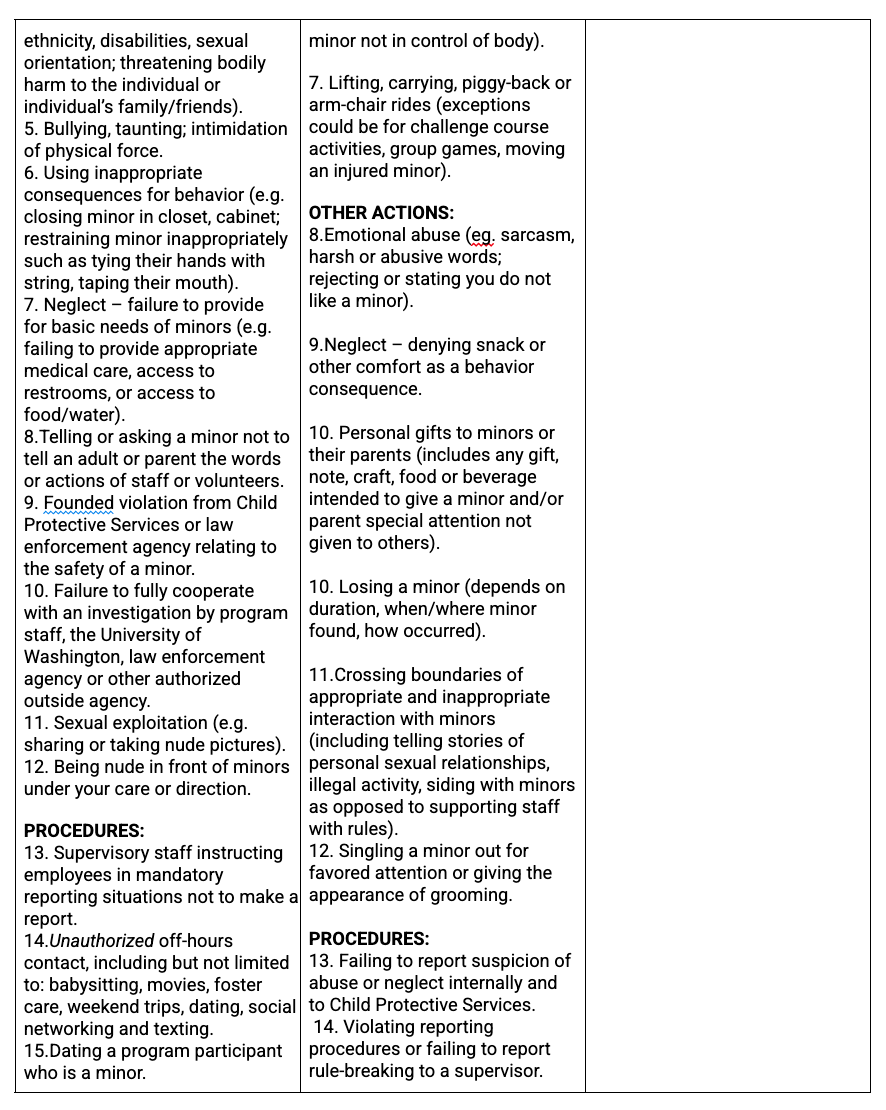
3. Appropriate & Inappropriate Interactions:
The following chart lists unacceptable and acceptable behaviors and actions with youth participants. It is intended to give clarity to unacceptable interaction between staff (employee or volunteer) and minors and the consequences for those actions. The lists are illustrative and not all-inclusive; other behaviors may be identified.